Thursday, February 25, 2021
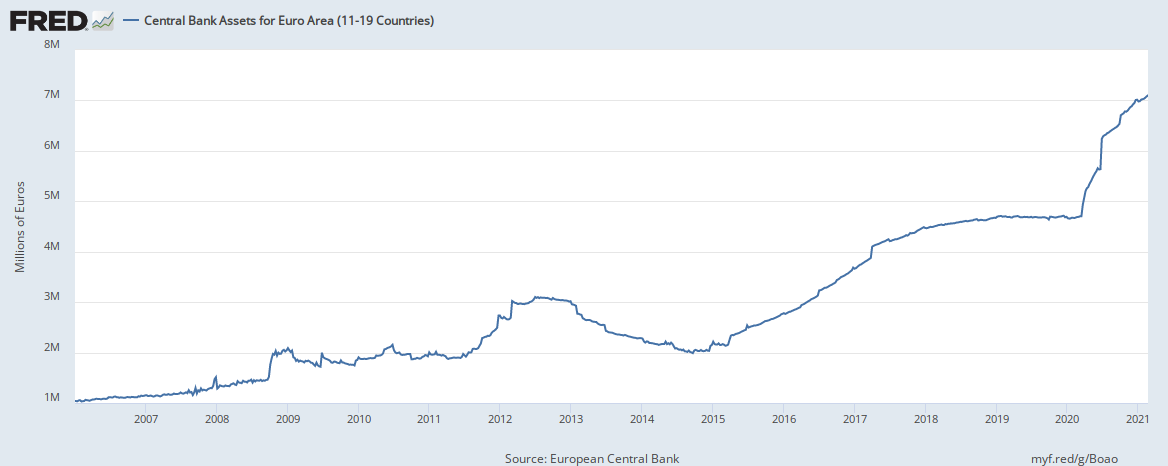
ECB and BOJ Balance Sheet – Other Beasts
Tuesday, February 23, 2021
How well statistics work: a lesson learned from Pfizer Covid Vaccine
Today I deviate somewhat from the financial markets to bring forth a relevant point that equally translates from the medical field. We look at the reported effectiveness of the Pfizer Covid vaccine. Please be advised that I do not have a personal opinion on the vaccine’s effectiveness; however, I merely report what it has been less obvious when reading the government data. Here I will take you through the process by which the reported effectiveness is derived and how it might not necessarily be obvious from the initial CDC reports.
The point above from the CDC is linked to its Morbidity and Mortality Weekly Report where it explains in further detail how the 95% effectiveness is derived. Specifically, the relevant section (copy/pasted below in italics and in parenthesis) states the following [with my comments in brackets]:
“The body of evidence for the Pfizer-BioNTech COVID-19 vaccine was primarily informed by one large, randomized, double-blind, placebo-controlled Phase II/III clinical trial that enrolled >43,000 participants (median age = 52 years, range = 16–91 years) (5,6).”
[My Comment: 43K seems like a large number of people
tested for a vaccine. My mind thinks:
this number of people from where the 95% effectiveness was derived.]
“Interim findings from this clinical trial, using data from participants with a median of 2 months of follow-up, indicate that the Pfizer-BioNTech COVID-19 vaccine was 95.0% effective (95% confidence interval = 90.3%–97.6%) in preventing symptomatic laboratory-confirmed COVID-19 in persons without evidence of previous SARS-CoV-2 infection.”
[My Comment: Here is the first catch: how many “symptomatic
laboratory-confirmed COVID-19 in persons without evidence of previous
SARS-CoV-2 infections” are we talking about? If they clearly call out this
group, it must mean that the 43K sample noted previously included people who
were infected or had been infected, or were not able to be determined. Nowhere
in the CDC article are we told the number of “symptomatic laboratory-confirmed
COVID-19 in persons without evidence of previous SARS-CoV-2 infections”]
“Consistent high efficacy (≥92%) was observed across age, sex, race, and ethnicity categories and among persons with underlying medical conditions.”
[My Comment: Presumably, this is representative of “symptomatic laboratory-confirmed COVID-19 in persons without evidence of previous SARS-CoV-2 infections”.]
“Efficacy was similarly high in a secondary analysis including participants both with or without evidence of previous SARS-CoV-2 infection.”
[My Comment: Here is another clue leading us to conclude
that the 43K sample included a mixed bag of people who were exposed to COVID.
But, again, nowhere in the CDC article are told of this breakdown.]
With that background and question at hand, namely, how many “symptomatic laboratory-confirmed COVID-19 in persons without evidence of previous SARS-CoV-2 infections” are there, we went to The New England Journal of Medicine where they clearly state that “[t]here were 8 cases of Covid-19 with onset at least 7 days after the second dose among participants assigned to receive BNT162b2 and 162 cases among those assigned to placebo; BNT162b2 was 95% effective in preventing Covid-19 (95% credible interval, 90.3 to 97.6).”
When you divide the 162 who did not get COVID by 170, and then multiply by 100, you then get the 95% vaccine effectiveness that is being widely reported. It is not, as you might be led to conclude, based on the 43K total being reported in the CDC article.
Lesson Learned: Always check the data and the critically think through categorical statements being made.
Saturday, February 20, 2021
Federal Debt Held by Private Market
Expanding from a previous post, it is concerning to observe the increase of public debt monetization by the Federal Reserve. Put differently, the private market holding of the public debt, based on rough estimate, has been on a general decline. As noted from the Table below, the estimated share of debt held by the public as of 2/18/2021 is about 53%, some 8% decline since September 2020. Now, the precision of these amounts are less of a concern, given that by the time this post is published or read, the amounts will have changed. What matters is the trend. And here we are seeing that the additional debt being issued is being gobbled up by the Central Bank at a faster rate when compared to the private market. At the logical extreme, the FRB will at some point be the only buyer in the market. But before that actually happens, expect yields to increase to account for the increase in counterparty risk.
[In billion of dollars]
*Total Privately Held has been adjusted to reflect FRB holdings, as reported by the FRBNY. February 2021 amounts obtained from US Treasury. Other amounts in Table come from US Treasury report, Table OFS2.
Thursday, February 18, 2021
Lender and Buyer of Last Resort
After the 2008-2009 Financial Crisis, it became fairly obvious that the FRB would be engaged in a more meaningful manner when another crisis would occur. Any doubt has been removed when we look at what happened at the outset of the 2020 Pandemic crisis. It is a fine distinction, albeit somewhat controversial at this point, that the economic distress that has been experienced since March 2020 has been the result of government policy and not the virus itself. In other words, had the various productive institutions of society – that is, those bearing the direct costs of policy decisions – been allowed to drive the health mitigation efforts perhaps the course taken would have been different. At this point, that counterfactual is purely an academic exercise. The present circumstances are what they are. That said, what this present crisis has brought to bear is the reality that the level of support to the markets by the FRB has been unprecedented, although not at all unforeseen. Below is a Table that highlights the various lending facilities initiated by the FRB, the markets impacted, and their amounts outstanding: close to $90 billion of support remains outstanding. If history is any guide, and the Japanese experience comes to mind, the market interventions in a future crisis by the FRB will continue to be more obvious and we will ultimately reach a point when it will effectively become the buyer of last resort for everything.
Source: Periodic Report: Update on Outstanding Lending Facilities
Monday, May 11, 2009
No Stress Over Stress Tests - Part II
********************************************************
Banks Won Concessions on Tests Fed Cut Billions Off Some Initial Capital-Shortfall Estimates; Tempers Flare at Wells
By DAVID ENRICH, DAN FITZPATRICK and MARSHALL ECKBLAD
The Federal Reserve significantly scaled back the size of the capital hole facing some of the nation's biggest banks shortly before concluding its stress tests, following two weeks of intense bargaining.
In addition, according to bank and government officials, the Fed used a different measurement of bank-capital levels than analysts and investors had been expecting, resulting in much smaller capital deficits.
The overall reaction to the stress tests, announced Thursday, has been generally positive. But the haggling between the government and the banks shows the sometimes-tense nature of the negotiations that occurred before the final results were made public.
Government officials defended their handling of the stress tests, saying they were responsive to industry feedback while maintaining the tests' rigor.
When the Fed last month informed banks of its preliminary stress-test findings, executives at corporations including Bank of America Corp., Citigroup Inc. and Wells Fargo & Co. were furious with what they viewed as the Fed's exaggerated capital holes. A senior executive at one bank fumed that the Fed's initial estimate was "mind-numbingly" large. Bank of America was "shocked" when it saw its initial figure, which was more than $50 billion, according to a person familiar with the negotiations.
At least half of the banks pushed back, according to people with direct knowledge of the process. Some argued the Fed was underestimating the banks' ability to cover anticipated losses with revenue growth and aggressive cost-cutting. Others urged regulators to give them more credit for pending transactions that would thicken their capital cushions.
At times, frustrations boiled over. Negotiations with Wells Fargo, where Chairman Richard Kovacevich had publicly derided the stress tests as "asinine," were particularly heated, according to people familiar with the matter. Government officials worried San Francisco-based Wells might file a lawsuit contesting the Fed's findings.
The Fed ultimately accepted some of the banks' pleas, but rejected others. Shortly before the test results were unveiled Thursday, the capital shortfalls at some banks shrank, in some cases dramatically, according to people familiar with the matter.
Bank of America's final gap was $33.9 billion, down from an earlier estimate of more than $50 billion, according to a person familiar with the negotiations.
A Bank of America spokesman wouldn't comment on how much the previous gap was reduced, though he said it resulted from an adjustment for first-quarter results and errors made by regulators in their analysis. "It wasn't lobbying," he said.
Wells Fargo's capital hole shrank to $13.7 billion, according to people familiar with the matter. Before adjusting for first-quarter results and other factors, the figure was $17.3 billion, according to a federal document.
"In the end we agreed with the number. We didn't necessarily like the number," said Wells Fargo Chief Financial Officer Howard Atkins. He said the company was particularly unhappy with the Fed's assumptions about Wells Fargo's revenue outlook.
At Fifth Third Bancorp, the Fed was preparing to tell the Cincinnati-based bank to find $2.6 billion in capital, but the final tally dropped to $1.1 billion. Fifth Third said the decline stemmed in part from regulators giving it credit for selling a part of a business line.
Citigroup's capital shortfall was initially pegged at roughly $35 billion, according to people familiar with the matter. The ultimate number was $5.5 billion. Executives persuaded the Fed to include the future capital-boosting impacts of pending transactions.
SunTrust Banks Inc. also persuaded the Fed to significantly reduce the size of its estimated capital gap to $2.2 billion, after identifying mathematical errors in the Fed's earlier calculations, according to a person familiar with the matter.
PNC Financial Services Group Inc., saw a capital hole materialize at the last minute. As recently as Wednesday, PNC executives were under the impression they wouldn't need to find any new capital, according to people familiar with the matter. Thursday morning, the Fed informed PNC that it had a $600 million shortfall.
Regulators said other banks also were told they needed more capital than initially projected.
The Fed's findings were less severe than some experts had been bracing for. A weeklong rally in bank stocks continued Friday, with the KBW Bank Stocks index surging 10%. Investors were especially relieved by the relatively small capital holes at regional banks. Shares of Fifth Third soared 59%, while Regions Financial Corp.'s $2.5 billion deficit led to a 25% leap in its stock.
With the stress tests, government officials were walking a fine line. If the regulators were too tough on banks, they risked angering their constituents and spooking markets. But if they were too soft, the tests could have lost credibility, defeating their basic confidence-building purpose.
All the back-and-forth is typical of the way regulators traditionally wrap up their examinations of banks: Regulators often present preliminary findings to lenders and then give them time to respond. The process can result in changes to the regulators' initial conclusions. Some of the stress-test revisions, for instance, were made to account for the beneficial impact of the industry's strong first-quarter profits.
On Friday, some analysts questioned the yardstick, known as Tier 1 common capital, that regulators chose to assess capital levels. Many experts had assumed the Fed would use a better-known metric called tangible common equity.
According to Gerard Cassidy, an analyst with RBC Capital Markets, the 19 banks' cumulative shortfall would have been more than $68 billion deeper if the government had used the latter metric, which accounts for unrealized losses.
Federal officials said their projections reflected the most comprehensive analysis ever conducted of the industry. The test results showed that the 19 banks faced a total of $599 billion in losses over the next two years under the government's worst-case, Depression-like scenario. The Fed directed 10 banks to add a total of nearly $75 billion to their capital buffers to insulate themselves from potential losses.
Banks pressed ahead on Friday with plans to fill their capital holes by tapping public markets. Wells Fargo raised $7.5 billion in stock through a public offering. The bank originally planned to raise $6 billion, but expanded the offering, which was valued at $22 a share, due to robust demand. Shares of Wells Fargo rallied $3.42, or 14% to $28.18.
Morgan Stanley, which is facing a $1.8 billion capital hole, raised $4 billion by selling stock. Shares of Morgan rose $1.06, or 4%, to $28.20.


